
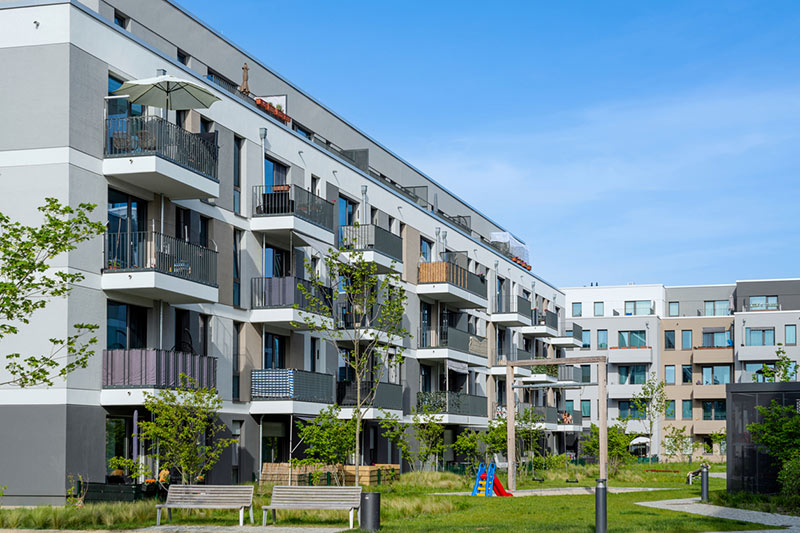


The ICO (Instituto de Crédito Oficial), through the “España Crece” program, has launched a funding instrument for affordable rental housing, with a budget of 12,150 million euros, designed to support affordable housing projects throughout their entire life cycle, ranging from development and construction to the long-term operation of affordable rental housing. Like projects financed by European funds,those financed by the ICO must comply with the same environmental requirements set forth in the EU Taxonomy and the Do No Significant Harm (DNSH) principle.
Need for Specific Instruments to Promote Affordable Rental Housing
One of the key factors in sustainability is the economic viability of projects. The development of affordable housing will not take place if investors cannot find the appropriate investment mechanisms to make it viable.
Developers who decide to enter this market segment must have adequate economic conditions and legal safeguards that allow them to play their part in solving the problem of housing affordability, taking advantage of the best conditions, since these are very long-term investments with lower risk and reasonable returns.
In order to provide appropriate financial instruments for the affordable housing development segment, in line with ensuring that affordable housing development projects are viable, as part of the strategies of the “España Crece Vivienda” program—in addition to promoting the development of strategic technologies and strengthening business growth— the program sets the following objectives: to increase the stock of housing designated for affordable rent and to drive the ecological transition.
These objectives represent one of the main challenges, not only in Spain but throughout Europe. The development of national mechanisms for financing affordable housing is an effort currently underway in parallel in most EU countries. Each country has historically faced different situations and specific characteristics in its real estate markets; therefore, each country needs its own strategy. The point on which all investors agree is that providing favorable legal and economic conditions for the affordable rental housing development sector allows for very attractive long-term returns.

Sustainability as a Cross-Cutting Theme in Financing
A plan with very long-term objectives must necessarily be approached with sustainability in mind. The construction sector accounts for a very significant portion ofCO2 emissions into the atmosphere; furthermore, energy costs—especially for families with moderate incomes— represent a significant portion of annual expenses. Therefore, building affordable housing that is not energy-efficient makes no sense.
But we must not only focus on the environmental and economic impacts; there are also other issues related to sustainable housing that are relevant: Greater comfort, efficient management, availability of alternative transportation services, lower water consumption, more durable facilities, communal spaces, ease of working from home, non-polluting materials, reduced on-site pollution, promotion of biodiversity, and a long list of other factors that are increasingly being incorporated into more and more projects.
Financing Options
As mentioned earlier, this is a financial instrument that supports the entire economic cycle of rental public housing, dividing the process into three phases or categories:
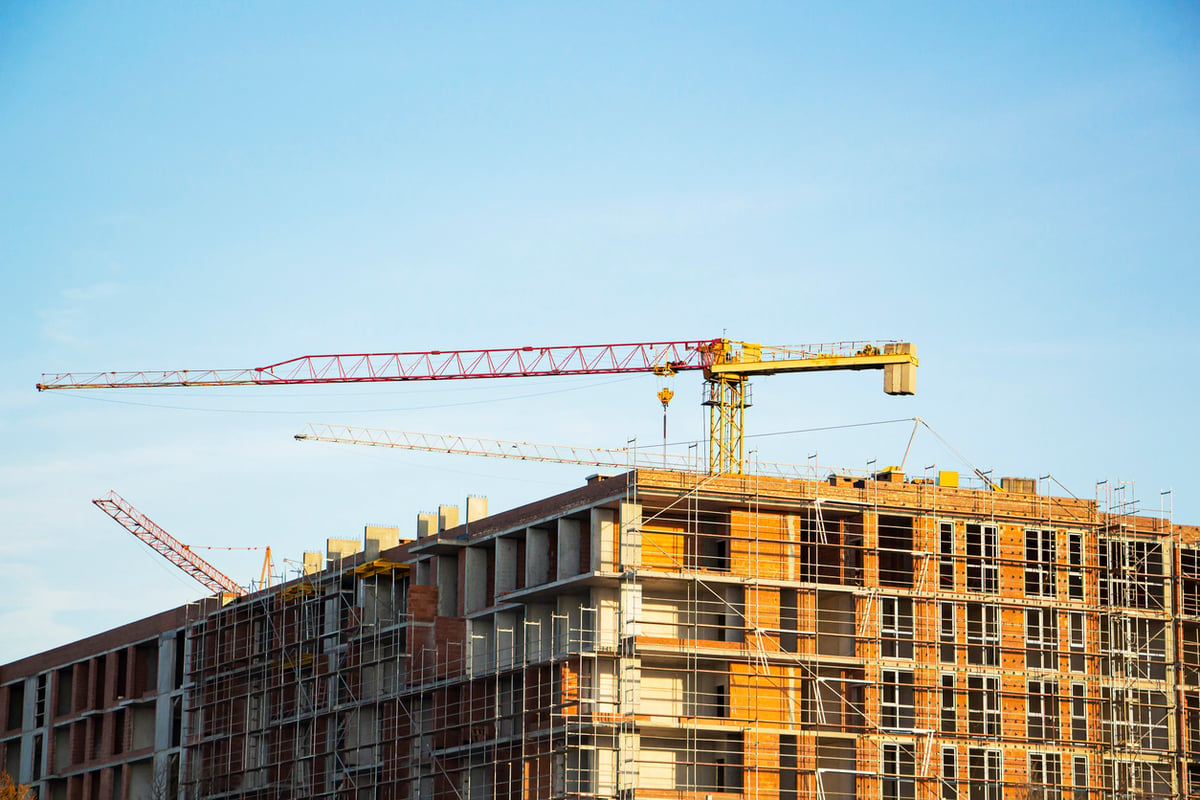
1. Option I — Developer Loan
- Purpose: Finances the production and construction phase of the affordable housing asset (whether new construction or comprehensive renovation of existing buildings), covering construction, marketing, and subsequent stable occupancy
- Key Structure: It combines a repayable loan at market rates with a Non-Repayable Tranche (NRT) that bridges the project’s financial viability gap
2. Option II — Investor Loan
- Purpose: To provide long-termfinancing for the ownership and operation of assets that have already been built or renovated and are in a stable rental situation.
- Key Structure: The loan is granted entirely at market rates (with no non-repayable portions) and offers two repayment options: the Amortizing Loan (general option for up to 28 years) or the Bullet Loan (special 7-year option contingent on a recent change of control)
3. Option III — Mixed Development and Holding Loan
- Purpose: Real estate development with the aim of retaining and managing the properties over the long term, avoiding the need to apply for and finalize two consecutive financing arrangements by combining—in a single transaction approved from the outset—construction/renovation work, the start of operations, and the subsequent asset-holding phase
- Key Structure: Maintains a single credit identity throughout its entire life cycle without requiring a new risk assessment or transfer of the asset upon transitioning to the ownership phase. Retains the Non-Reimbursable Tranche (NRT) from Modality I to bridge the viability gap for the construction work.
What is the profitability gap, and how is the non-repayable tranche calculated?
The main feature of this instrument is that it recognizes the profitability gap in affordable rental housing projects for developers. This gap is understood as the financial difference that arises when the net return (Yield on Cost) of an affordable housing project falls below the return demanded by the market.
To cover this gap, a Non-Reimbursable Portion (NRP) is created; this is government aid integrated into the principal of the ICO loan and intended to cover this viability gap. It acts as a residual measure after deducting other subsidies or the land benefit; it cannot exceed 30% of the total financing and is permanently forgiven if the housing protection and rental requirements are met.
Sustainability Assessment
Like all Next Generation funds—from which the instrument’s funds are partially derived—the environmental sustainability and energy efficiency framework for the ICO financing line is structured around the principle of “do no significant harm to the environment” (DNSH) and climate labeling, as regulated by European and national legislation.
Climate Change Mitigation Requirements (Energy Efficiency)
The following climate change mitigation (energy efficiency) requirements are established for projects, which must be demonstrated through energy labeling.
New Construction:
- Primary energy demand must beat least 20% lower than the national requirement for Nearly Zero-Energy Buildings (EECN).
- Non-renewable primary energy consumption (Cep,nre) must not exceed 80% of the limit set in Section HE 0 of the Technical Building Code (CTE).
Renovation:
- A reduction of at least 30% in non-renewable primary energy consumption compared to the pre-renovation state, calculated using a standardized methodology.
Single environmental validation
The instrument allows for the evaluation and verification of compliance with environmental requirements just once per asset and project across the entire financial instrument. Therefore, assets that have already obtained a favorable Environmental Validation under any of the ICO’s modalities (for example, during the construction phase under Modality I or III) may incorporate that result by reference in subsequent applications under the other modalities, thereby avoiding duplicate procedures and preventing double counting of contributions.
When is Environmental Validation required?
Validation is carried out through an ex ante project report and an evaluation during implementation to verify compliance with DNSH requirements.
- External assets or equivalents: If a property enters Modality II without having gone through Modalities I or III (for example, completed assets purchased from third parties), it must undergo an initial comprehensive Environmental Validation by the ICO. Prior validation by other banks or sellers does not substitute for that of the ICO
- Portfolio transactions: Each property is reviewed individually; properties that have already been validated are incorporated by reference, and new ones must be examined individually
- Substantial modifications: If the building undergoes subsequent substantial renovations to its building envelope or energy systems, the ICO must be notified prior to their implementation to verify that the validated environmental conditions are not compromised
What are the requirements for the environmental assessment?
As I mentioned earlier, the environmental assessment must comply with the requirements of the principle, including the energy efficiency aspects (climate change mitigation) indicated above through the energy certificate and compliance with climate goals
- Climate risks and adaptation to climate change
- Sustainable use and protection of water resources
- Transition to a circular economy
- Pollution prevention and control
- Protection and Restoration of Biodiversity
Conclusions
The market for affordable public housing rentals has guaranteed demand. The new financing instrument makes it possible to develop these types of projects by bridging the profitability gap. It is a very practical mechanism designed for developers seeking stable, long-term, low-risk returns.
It is unacceptable for these types of projects to be exempt from the environmental requirements applicable to any other project. Therefore, compliance with Taxonomy and DNSH requirements is mandatory when granting this financing. At Zero Consulting, we manage compliance with environmental requirements. You can download the guide below or learn in detail how these requirements are applied in this article on Taxonomy and DNSH.
